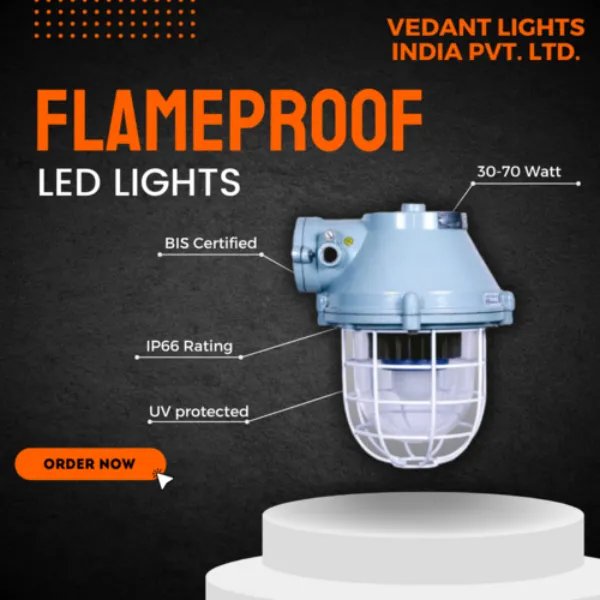
Certain industrial environments contain hazards that make ordinary lighting equipment unsuitable. An LED Flameproof Light is designed for specific hazardous-area applications where equipment selection must account for the surrounding atmosphere plus applicable safety requirements.
For industrial facilities around Pune, including manufacturing clusters with process plants, chemical operations, specialised production units, hazardous-area lighting should always begin with proper area assessment.
Hazardous Areas Need Specific Equipment
The term flameproof does not simply mean that a fixture can withstand high temperature.
Hazardous locations may contain flammable gases, vapours, combustible materials under defined operating conditions. Electrical equipment used in these areas may need construction plus certification suitable for the identified hazard.
This makes area classification an essential first step.
The lighting fixture should never be selected solely because a product description contains the word flameproof.
Start With Hazardous-Area Classification
Before purchasing lighting equipment, the facility team should establish the classification of the installation location through qualified engineering personnel.
This assessment considers factors such as:
- Hazardous substance present
- Likelihood of its presence
- Duration of potential exposure
- Process conditions
- Ventilation
- Applicable standards
- Required equipment classification
Once the area has been properly classified, lighting products can be evaluated against those requirements.
Typical Industrial Applications
Flameproof lighting can be relevant across specialised industrial environments where hazardous atmospheres may occur.
Examples can include certain sections within:
- Chemical processing facilities
- Paint manufacturing units
- Solvent handling areas
- Petrochemical facilities
- Oil handling locations
- Process plants
- Fuel-related installations
- Selected pharmaceutical processes
Not every section within these facilities automatically requires the same equipment.
The actual requirement depends on formal area classification.
Certification Needs Careful Verification
Industrial procurement teams should request applicable certification details before approving a fixture.
A catalogue image alone cannot demonstrate suitability.
Check the exact product model, certification scope, relevant markings, environmental rating, installation conditions.
Project documentation should also be maintained so maintenance teams can identify approved equipment later.
Enclosure Construction Matters
Hazardous-area fixtures need robust construction appropriate to their intended environment.
Industrial buyers may need to examine housing material, sealing arrangements, cable entry design, mounting method, thermal characteristics.
Installation accessories can also matter.
Using an appropriate fixture with unsuitable cable entries, glands, wiring practices can compromise the intended installation approach.
Thermal Conditions Must Be Considered
Industrial environments can expose lighting equipment to elevated ambient temperatures.
The thermal suitability of a fixture should be checked against actual site conditions plus relevant hazardous-area requirements.
Heat from nearby process equipment may influence the local operating environment.
This is another reason why catalogue wattage alone provides insufficient information for product selection.
Installation Requires Qualified Personnel
Correct product selection is only one part of hazardous-area lighting safety.
Installation practices are equally important.
Electrical teams should follow applicable drawings, manufacturer instructions, project specifications, statutory requirements.
Improvised modifications to certified equipment should be avoided.
Maintenance personnel also need to understand that hazardous-area fixtures cannot necessarily be treated like ordinary indoor luminaires.
Inspection Should Continue After Commissioning
Industrial conditions can change over time.
Vibration, corrosion, dust, moisture, mechanical impact, maintenance activities may affect equipment condition.
Facilities should establish inspection procedures appropriate to the installation.
Checks may include visible enclosure condition, mounting security, cable entry integrity, abnormal damage, unauthorised modifications.
Any maintenance intervention should preserve the required safety characteristics of the installation.
Procurement Should Begin With Technical Data
An LED Flameproof Light should be chosen through engineering information rather than appearance, price, brightness alone.
For industrial buyers in Pune, Maharashtra, a useful enquiry should include the hazardous-area classification, ambient conditions, mounting requirement, electrical specification, certification expectations, required illumination.
This information allows manufacturers plus technical suppliers to evaluate suitability more responsibly.
Hazardous-area lighting is ultimately a safety-critical engineering decision. Correct classification, verified product documentation, suitable installation, disciplined maintenance provide a stronger foundation than selecting a fixture through general commercial specifications.
Keywords